










And Why Unanchored Technique Matters
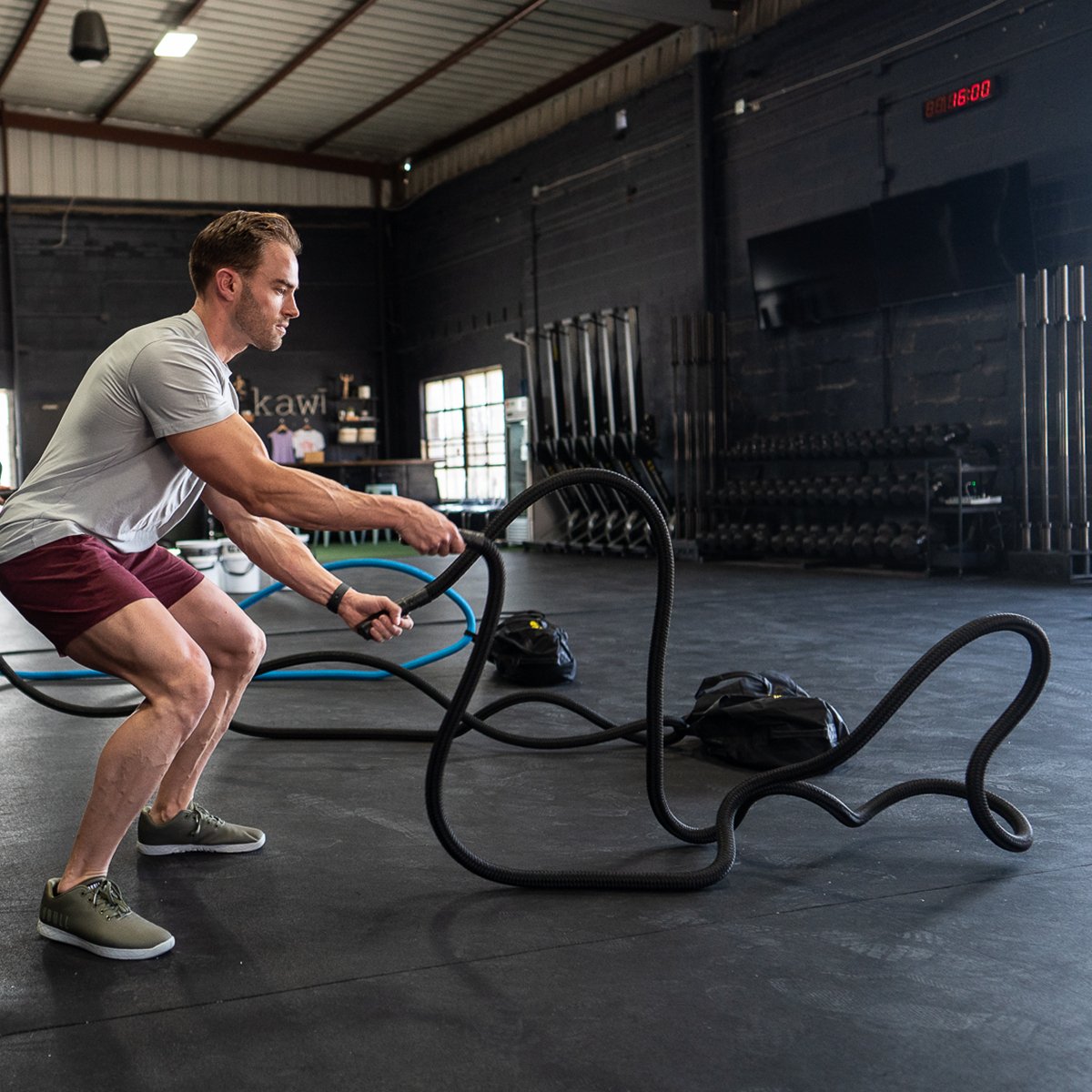
Battle ropes are a proven conditioning tool — but traditional battle ropes come with real drawbacks. Unlike Hyperwear's weighted battle rope they require long open spaces, permanent anchor points, and often rely on inefficient movement patterns that mask poor technique.
Hyper Rope® weighted battle ropes were invented to solve those problems.
Hyper Rope® weighted battle ropes were invented to solve those problems by increasing active mass while eliminating the need for anchors and large spaces.
At first glance, Hyper Rope looks shorter and lighter than a traditional 45–50 ft battle rope. Yet many athletes report that it feels just as intense — or more so.
The reason isn’t marketing. It’s physics, and it’s how unanchored training changes movement.
The Problem With Traditional Battle Ropes
A typical large battle rope looks like this:
-
Length: 45–50 ft
-
Weight: ~40–45 lb
-
Diameter: 1.5–2 in
-
Anchor required: Yes
-
Space needed: 25–30 ft of clear floor
Why Battle Rope Training Is So Effective
Battle rope training is widely recognized for delivering high cardiovascular demand, full-body muscle activation, and rapid fatigue, even in short work intervals.
Independent research confirms that battle rope training:
-
Produces high heart rate responses
-
Engages upper body, core, and lower body simultaneously
-
Delivers significant metabolic demand in short timeframes
According to research published by the American Council on Exercise (ACE), battle rope workouts can significantly improve cardiovascular and muscular endurance while producing high oxygen consumption and calorie burn.
What Hyper Rope changes is how that demand is created — by increasing the amount of rope mass that is actually moving, rather than relying on excessive length and anchors.
Traditional ropes rely on length and diameter to create resistance. But during waves, not all of that rope mass is actually moving.
Much of it stays on the floor, absorbing energy through friction.
Active Mass: The Metric That Actually Matters
Active Mass = Rope Weight × Length That’s Moving
When you create battle rope waves, only the portion of rope that lifts, accelerates, and decelerates contributes to training demand.
Traditional Rope Reality
Using a 50 ft / 45 lb rope:
-
Weight per foot ≈ 0.9 lb / ft
-
Typical active length during waves ≈ 8–15 ft
-
Active mass moved: ≈ 7–14 lb
Despite the rope weighing 45 lb, most of that mass never leaves the floor.
Why Hyper Rope Feels Different
Hyper Rope flips the traditional design.
Instead of spreading weight across excessive length, Hyper Rope uses a patented flexible weighted internal core that allows a much larger percentage of the rope to move — even in compact spaces.
Hyper Rope Active Mass by Size
-
20 ft · 15 lb → active mass up to 15 lb
-
25 ft · 19 lb → active mass up to 19 lb
-
30 ft · ~23 lb → active mass up to ~23 lb
In real-world training, Hyper Rope can deliver ~1.5–2.5× more active mass than a traditional 50 ft rope, depending on athlete strength and technique.
Space & Setup Comparison
| Feature | Traditional Rope | Hyper Rope |
|---|---|---|
| Space Required | 25–30 ft | 6–10 ft |
| Anchor Required | Yes | No |
| Setup Time | High | Low |
| Portability | Low | High |
Hyper Rope is the ideal battle rope alternative for small spaces:
-
Home gyms
-
Training studios
-
Performance facilities
-
Physical therapy clinics
Anchored vs Unanchored Training: Why Technique Changes
This is where many first-time users notice a difference.
What Most Athletes Learn on Traditional Ropes
With anchored battle ropes, athletes often:
-
Lean back
-
Sit into their hips
-
Pull against the anchor
This works because the anchor provides a fixed reaction force. It allows athletes to rely on bodyweight and backward lean rather than balance and force projection.
The Unanchored Hyper Rope Difference
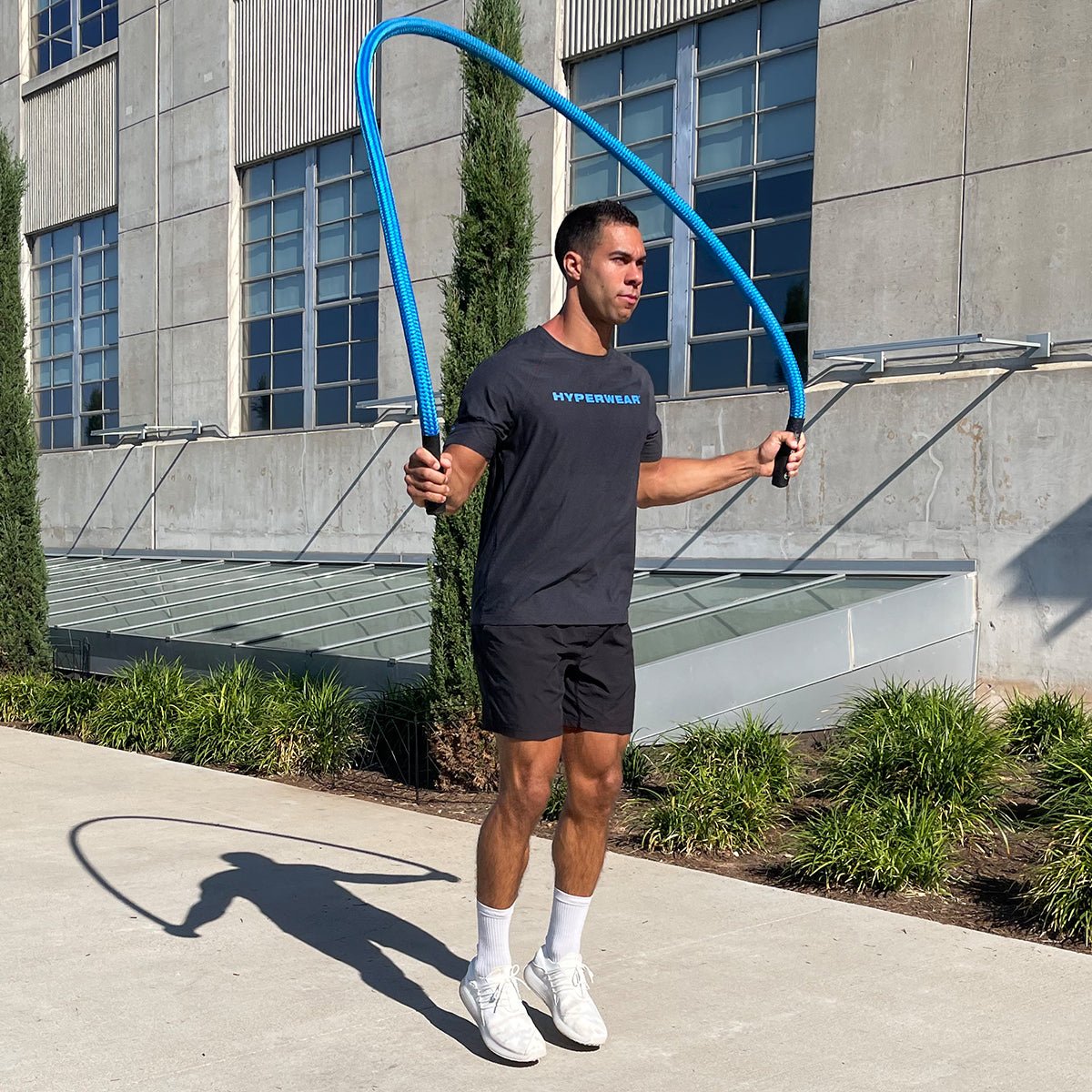
Hyper Rope is designed to be used without an anchor.
Without a fixed reaction point:
-
Leaning back shortens the system
-
Pulling collapses the waves
-
The rope may bunch up at the feet
This isn’t a flaw — it’s physics enforcing honesty.
To keep the rope moving unanchored, athletes must:
-
Stay balanced over mid-foot
-
Stand tall with ribcage stacked over pelvis
-
Keep hands in front of the body
-
Project force forward and downward
Anchored vs Unanchored Battle Rope Technique

Traditional ropes allow anchor-assisted leaning. Hyper Rope trains balanced force projection without relying on an anchor.
Why Unanchored Training Is a Benefit
Unanchored Hyper Rope training increases demand on:
-
Anterior core stabilization
-
Shoulder and scapular control
-
Grip endurance
-
Whole-body coordination
-
Deceleration and control under fatigue
These demands better reflect real athletic movement patterns found in:
-
Sprinting
-
Throwing
-
Striking
-
Field and court sports
By removing anchor-assisted cheating, Hyper Rope trains cleaner, more athletic movement. It is a fundamental part of Hyperwear's family of cardio strength conditioning training tools.
Can You Anchor Hyper Rope?
Yes. Some athletes choose to anchor Hyper Rope for a more traditional feel.
-
Anchored: familiar wave patterns, symmetrical feel
-
Unanchored: maximum active mass, smallest footprint, higher stabilization demand
Same rope. Two training modes.
Choosing the Right Hyper Rope
20 ft · 15 lb
Best for most users, longer intervals, skill development
25 ft · 19 lb (Elite)
Higher conditioning demand, stronger athletes
30 ft · ~23 lb (Elite 30)
Peak intensity, short power intervals, commercial and advanced use
Quick guide:
If you can sustain clean waves for 60+ seconds, consider moving up a size when deciding on Hyper Rope training options.
Why Hyper Rope Is a True Battle Rope Alternative
Hyper Rope doesn’t just make battle rope training smaller — it makes it smarter.
By increasing active mass and removing anchor dependency, it delivers:
-
Higher intensity in less space
-
Better movement quality
-
Greater conditioning return per rep
Traditional battle ropes solved resistance with length.
Hyper Rope solves it with physics and design.
Conclusion
If you want the conditioning benefits of battle ropes without dedicating half your gym to a single tool, Hyper Rope isn’t a shortcut — it’s an evolution.
Once athletes adjust technique, the payoff is clear:
more active mass, better movement, and serious conditioning — in a fraction of the space.